
📦 Archived back issue: This Weekly Brief back issue was originally published on LiveMakers.com (2026-05-30). From Issue #13 the Brief continues on SIPO.TOKYO.
The First Verdict — Cardano Ratifies 131M ADA in Allocations as the Market Splinters into Three Clocks
Published: 2026-05-30 JST · Epoch: 634 (633→634 transition 2026-05-30) · Issue #8
Executive Summary
W22 will be recorded as the week governance handed down its first verdict. Having stepped to the threshold of its “governance phase” in W21, Cardano in W22 actually adjudicated Input Output’s (formerly IOHK) 2026 treasury slate — DReps ratified the major build proposals to lock in 131M ADA of allocations, while leaving Pogun Bitcoin DeFi, Blockfrost, and Layer-2 Scalability un-passed and keeping Input Output Research (32.9M ADA) still in voting. The shift from “the framework is in place” to “capital is actually being allocated — and sometimes rejected” was completed, this time with numbers attached.
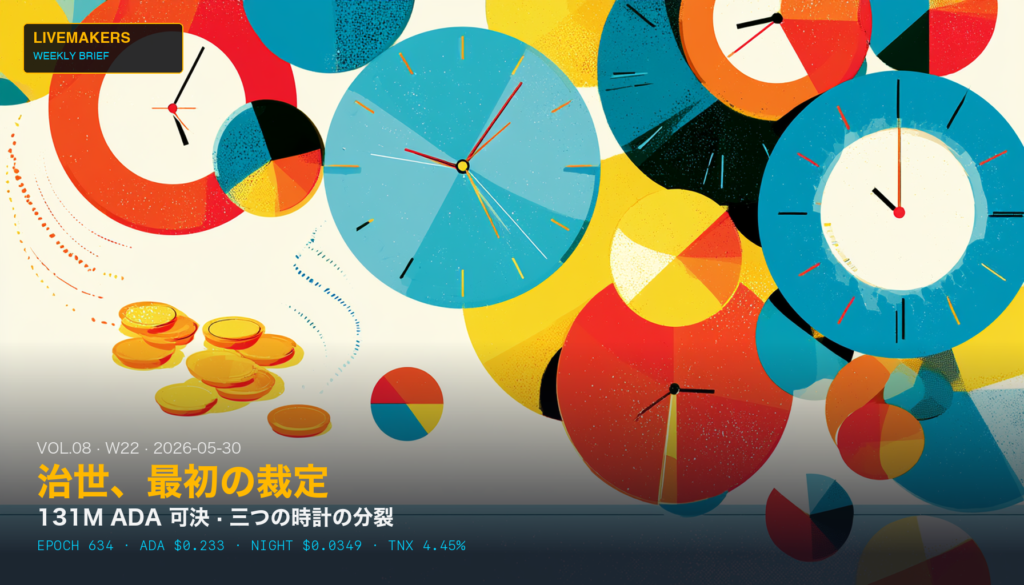
But the market as a whole did not synchronize with that decision. W22 was, instead, a week in which three clocks ran at different speeds.
The first clock (governance) ran fast. IO’s treasury proposals received the DReps’ verdict within days, and 131M ADA was confirmed. What matters is that not everything passed — the very existence of rejections is the clearest proof that Cardano governance is not an automatic rubber-stamp for IOG. The governance phase moved past its threshold and rendered its first judgment.
The second clock (equities) set records. The S&P 500 logged its ninth straight weekly gain (7,580), the Dow closed above 51,000 for the first time (51,032), the Nikkei reached 66,220 (+4.61%), and the VIX fell to 15.32 (-8.26%). Collapsing oil (WTI -9.53% / Brent -11.78%) and low volatility fueled a melt-up in traditional risk assets.
The third clock (long rates) began to turn the other way. In Warsh’s first week as Fed Chair, the bond market reacted not with easing but with hawkishness — the 2-year yield hit roughly 4.14% on Friday (a more-than-one-year high), the 30-year briefly touched ~5.2%, and the market began pricing a rate hike within 2026 (reported). April PCE printed +3.8% year-on-year (core +3.3%), nearly double target. The coexistence of front-end volatility easing and long-end yield stress — a bear-steepening — qualitatively rewrote W21’s “four-point easing.”
And crypto rode none of the three clocks. BTC -3.04% / ETH -2.85% / ADA -5.02% / XRP -1.49% / SOL -3.59% extended a third consecutive week of declines, and spot Bitcoin ETFs posted nine straight sessions of net outflows (the longest streak since January 2024), totaling roughly $2.8B. As equities set records, digital assets alone stayed in their own corrective regime.
The lone exceptions were NIGHT +5.81% (a second consecutive positive week) and the idiosyncratic strength of AI-linked tokens (FET +22.57% / ICP +5.18% / ALGO +5.37%). With the main tracked set (BTC/ETH/ADA/XRP/SOL) all lower and ADA down -5.02% over the same window, NIGHT rising for a second straight week represents the continuation of the decoupling signal observed in W21’s “price-lagging, usage-leading” hypothesis. Midnight itself pushed its story forward on 5/29, when IOG announced that the network’s “guarded period is ending → next hard fork.”
The core of reading W22 lies in the splintering of three clocks: governance decided, price did not respond, and long rates turned the other way. Cardano has moved beyond “assembling the materials” into “rendering verdicts.” The market’s price mechanism, meanwhile, split three ways — an equity melt-up, a hawkish bond repricing, and a crypto correction. The investment implication is a two-stage posture: short-term (1-4 weeks), watch crypto’s internal independent axes (NIGHT, AI tokens) and the spillover of the hawkish long-end repricing into risk assets; medium-term (2026 H2-2027), trace where the confirmed 131M ADA actually lands in the implementation pipeline, and whether Midnight’s Mōhalu phase (mid-2026) substantiates the NIGHT decoupling with real usage data.
1. Market Pulse — Equities at Records, Long Rates Reverse, Crypto Left Behind
Week-over-Week (W21 reference snapshot → W22 reference snapshot)
Reference timestamps: W21 reference = 2026-05-23 09:00 UTC / W22 reference = 2026-05-30 09:00 UTC. Crypto is CoinGecko spot at the reference timestamp; traditional markets are the last NY close prior to reference (W22 = Friday 2026-05-29 NY close). See meta.json
data_sourcesfor detail.
| Asset | W21 ref | W22 ref | W-o-W Δ | Note |
|---|---|---|---|---|
| BTC | $75,702 | $73,404 | -3.04% | Below $73K · 3rd straight weekly decline · 9-day spot-ETF outflow streak |
| ETH | $2,070.5 | $2,011.4 | -2.85% | Contesting $2,000 |
| ADA | $0.24522 | $0.23292 | -5.02% | Governance verdict did not reach price |
| NIGHT | $0.03302 | $0.034937 | +5.81% | 2nd straight positive week · decoupling from ADA’s decline |
| SOL | $84.88 | $81.83 | -3.59% | Tracking risk assets |
| XRP | $1.34 | $1.32 | -1.49% | Relatively resilient |
| ALGO | $0.11358 | $0.11968 | +5.37% | One of few L1 gainers |
| DOT | $1.28 | $1.19 | -7.03% | High-beta decline |
| ATOM | $2.08 | $2.02 | -2.88% | Giveback of W21’s +7.77% |
| ICP | $2.51 | $2.64 | +5.18% | Rebound on AI narrative |
| FET | $0.19993 | $0.24507 | +22.57% | Strongest of the week · AI-token idiosyncratic |
| WLFI | $0.06018 | $0.05869 | -2.47% | Continued softness |
| WTI | $97.00 | $87.76 | -9.53% | Slid on Iran developments (deal unsigned) |
| Brent | $103.94 | $91.70 | -11.78% | Largest monthly drop since 2020 |
| Gold | $4,510.5 | ~$4,520 | ~flat | Elevated · sources span $4,484–4,570 · settle to be reconfirmed |
| DXY | 99.319 | 98.94 | -0.38% | Continued dollar softening |
| VIX | 16.70 | 15.32 | -8.26% | Fear gauge eased into the 15s |
| SPX | 7,473.5 | 7,580.1 | +1.43% | 9th straight weekly gain |
| Nasdaq Comp | 26,343.97 | 26,972.6 | +2.39% | ~+8% on the month |
| DJI | 50,579.7 | 51,032.5 | +0.90% | First close above 51,000 |
| Nikkei | 63,300.0 | 66,220.0 | +4.61% | Near record highs |
| US 10Y | 4.558% | 4.453% | -10.5 bp | ※ 2Y and 30Y moved higher (below) |
| USDJPY | 159.155 | 159.255 | +0.06% | Flat below 160 |
| COIN | $184.99 | $189.03 | +2.18% | Crypto equity diverged from crypto itself |
Macro regime — volatility eased, but long rates turned hawkish under Warsh
Reading W22’s macro as “continued easing” misses the essence. What eased was the entry point of volatility and risk appetite; the term structure of rates, by contrast, moved the other way.
The easing side was clear — VIX fell from 16.70 to 15.32 (-8.26%) into the 15s, oil collapsed (WTI -9.53% / Brent -11.78%, Brent’s largest monthly drop since 2020), and the dollar softened further (DXY -0.38%). The US 10-year also eased from 4.558% to 4.453% (-10.5 bp). To here it looks like an extension of W21’s “four-point easing.”
But in Warsh’s first week as Chair, the bond market responded with hawkishness, not easing. The 2-year yield hit roughly 4.14% on Friday (5/29), a more-than-one-year high, and the 30-year jumped to ~5.2% (2007 levels) intraweek before retreating into the 5s (reported, market-data-backed). Even the dovish Governor Waller was reported to say the next move is “just as likely a hike,” and the market shifted to pricing zero rate cuts in 2026 as the base case (Polymarket ~66%), with some pricing a hike. Behind this sits April PCE at +3.8% y/y (core +3.3%), nearly double target. In other words, W22’s yield curve combined front-end easing (10Y -10.5 bp) with long-end and short-end stress (30Y up, 2Y up) — a bear-steepening — better read as a “qualitative change in easing” than a “continuation of easing.”
The oil collapse also warrants care. The -10%-class drop in WTI/Brent reflects the market front-running a US–Iran ceasefire framework, but that framework was not signed or finalized as of 5/30 (pending Trump’s final approval; actual military exchanges were also reported mid-week). Oil has priced “a deal not yet signed,” carrying reversal risk if the deal breaks. We treat this as “front-running a ceasefire framework,” not “a ceasefire achieved.”
Equities set records, crypto left behind for a third week
W22’s defining structural observation is that the equity–crypto desynchronization widened to the level of “records vs. correction.” The S&P logged a ninth straight weekly gain (7,580), the Dow closed above 51,000 for the first time, the Nasdaq Composite was up ~+8% on the month, and the Nikkei hit 66,220 (+4.61%). Low VIX, cheap oil, and soft-landing hopes staged a melt-up in traditional risk assets.
Crypto, meanwhile, extended a third straight week of declines — BTC -3.04% / ETH -2.85% / ADA -5.02% / SOL -3.59% / DOT -7.03%. The decisive factor was flows: spot Bitcoin ETFs ran nine straight sessions of net outflows through 5/29 (the longest since January 2024), roughly $2.8B in total and ~$1.3B in the week (reported · CoinDesk). On a single day, IBIT saw ~$527.84M of outflows on 5/27 (the second-largest ever). As equities set records, digital assets alone were left behind in a correction accompanied by capital outflows — the confirmation and intensification of W21’s “crypto does not respond to macro easing” thesis. The difference: W21 was “macro eased but crypto held flat,” whereas W22 deepened into “equities at records, but crypto in an outflow-driven real decline.”
NIGHT +5.81% and AI tokens — the decoupling continues
The gainers in W22 sat outside the main tracked set (BTC/ETH/ADA/XRP/SOL, all lower) — NIGHT +5.81% / FET +22.57% / ICP +5.18% / ALGO +5.37% — each for distinct structural reasons.
NIGHT posted a second straight positive week (W21 +1.21% → W22 +5.81%). Looking at the daily path, however, it peaked intraweek on 5/24, drifted lower through 5/26, and recovered into the weekend (around the 5/29 IOG “guarded period ending” announcement) — meaning no single clear catalyst ran within the week. The +5.81% is best read as the echo of the 5/22 Midnight City V2 launch (a W21 event) compounded by a weekend recovery. The claim circulated by some outlets that “a Morpho integration drove NIGHT” actually concerns Coinbase’s Base (Base MCP) and is unrelated to Midnight; we do not adopt it. What matters is the decoupling itself — NIGHT rose +5.81% while ADA fell -5.02% over the same 5/23→5/30 window. NIGHT is beginning to trade on its own ecosystem narrative rather than as Cardano-L1 beta (detailed in §4).
The AI-token cohort (FET +22.57% / ICP +5.18%) rose not on a broad crypto risk-on but on a narrative-rotational bid — as capital exited crypto, what remained concentrated in the AI-agent / decentralized-AI theme. ALGO +5.37% was one of few L1 gainers, likely on its own initiatives.
The pattern reveals a two-layer structure: capital is retreating from “crypto as an asset class” while internally rotating into selective narratives (AI, privacy). For the Cardano ecosystem, NIGHT’s independent strength is a sign that a “value axis not dependent on the broad market’s direction” is forming — a medium-term positive signal.
2. Ecosystem Watch — van Rossem “Did Not Rush,” Plutus Went to Mainnet, Leios Got June 23
Reading W22 through Cardano’s implementation and development lens, the single biggest observation is that the most important hard fork (van Rossem), put to a vote on schedule on 5/29, was not rushed to ratification. This was not a delay but a display of governance discipline.
van Rossem HF — voted 5/29, but the Hard Fork Working Group withheld ratification (Ogmios)
As W21 §6 previewed (“van Rossem HF mainnet submission target 5/29”), the van Rossem (V11) mainnet governance vote was scheduled for 5/29. But the outcome was not a simple “passed and enacted” — the Hard Fork Working Group withheld its formal ratification recommendation over concerns about Ogmios (infrastructure-layer) readiness (reported, consistent across aggregators). IOG and community engineers are resolving Ogmios fixes; satisfying the three-layer sign-off (CC / DReps 67% / SPOs) means the effective fork execution slips into a June window.
This was the week’s most instructive embodiment of “submitted ≠ ratified ≠ enacted.” The discipline of “Cardano did not rush; it prioritized safety” aligns with a design philosophy that values reliability as long-term infrastructure. SPO readiness advanced: node v11.0 block production reached 56% at Epoch 633 (up from ~21% on 5/18 · Intersect official). DB-Sync 13.7.1.0 (HF-compatible, fixing an epoch-table bug) was also released, assembling the auxiliary infrastructure to cross the fork safely. Enactment itself stands at “June, conditions permitting.”
Plutus Cost Model went live on mainnet (5/26)
Separately from van Rossem, the Plutus Cost Model update went live on mainnet on 5/26 (Intersect official). After staged validation through SanchoNet → Preview → PreProd, it makes new Plutus primitives available across V1/V2/V3 and ensures consistency — an implementation that directly improves smart-contract expressiveness and cost efficiency, advancing independently of van Rossem (a ledger storage-backend overhaul).
Leios testnet moved from “June” to “June 23”
The Ouroboros Leios testnet, previously announced for “June,” obtained a concrete date of June 23 (aggregate-sourced · primary reconfirmation advised). The Consensus-series treasury proposal that includes Leios (27.7M ADA) passed with ~84% DRep approval (aggregate-sourced). Leios positions 2026/2027 as the maturation from prototype to mainnet, aiming to lift monthly transactions from the current few hundred thousand to 27M+ (a 2030 vision) as the core of scaling. A structural answer to years of “they abandoned scaling” criticism took concrete form as a testnet date.
Epoch 634 began · Hydra Voting budget process · operations layer
Epoch 634 began on schedule on 5/30 (confirmed via Koios live tip · as W21 previewed). A caching lag left some Dune queries showing 633, but the on-chain source of truth reflects the transition to 634.
On the governance-budget side, Intersect opened the “Hydra Voting for the 2026 Budget Process” on 5/26 (through 6/12). The 69 ecosystem-budget proposals submitted by the 5/8 deadline entered the phase of moving through the off-chain Hydra voting tool (≥67% DRep stake to advance to an on-chain Treasury Withdrawal). ※ “Hydra Voting” here refers to the voting mechanism/tool and is distinct from the Hydra L2 scaling protocol. Mithril signer v1.0.0 also reached production-ready, bringing lightweight-sync infrastructure to production quality.
DeFi / dApps — Liqwid V2, TVL, and a Bitcoin-DeFi recount
In DeFi, Liqwid Finance V2 (LIP-147) went live on mainnet and open-sourced its code on 5/26 (a lending-protocol transparency milestone · reported). In wallets/infra, Lace 2.06 and Yaci Store 2.0.1 (a modular indexer) shipped. Cardano TVL sits at ~$128–132M (DefiLlama), soft-to-flat in step with ADA’s weakness.
Bitcoin-DeFi required cleanup. “BTC Karma,” referenced in the W21 brief as Cardano’s first Bitcoin-DeFi protocol, could not be confirmed in any primary or major secondary source, so it is not carried in this issue. The real Cardano Bitcoin-DeFi initiatives are Pogun (lending · though its budget vote did not pass this week), Cardinal (IOG BTC interoperability), Sundial, and FluidTokens (which achieved a native BTC↔ADA atomic swap in March). Separately, ATLAS (leveraged perps) launched a public testnet on 5/21-22, with mainnet TBD. The fact that multiple perp platforms (Strike, ATLAS, etc.) are standing up on Cardano at once is a DeFi-2.0 competitive theme worth watching.
3. Governance Update — 6 Approved, 3 Rejected, 131M ADA, and What “Rejection” Means
W22’s governance layer moved on two axes — Cardano-internal treasury adjudication (the approval/rejection of IO proposals) and US/Japan macro-regulation (Warsh’s first Fed week / CLARITY un-voted / CME 24/7 / FSA ordinances enforced 6/1). The former is the week’s protagonist.
Cardano IO budget verdict — 131M ADA across 6 build proposals approved, 3 rejected
IO’s 2026 treasury slate (totaling ~166M ADA / ~$46.8M), which in W21 stood “on the DReps’ decision table,” was actually adjudicated in W22. The result split in two (IOG official 5/26 · 5/29):
- Approved (6 build proposals · 131M ADA total): Cardano Upgrades (= the proposal W21 called “Three Capabilities”: CIP-159 extended addresses + CPS-23 multi-asset treasury + Babel Fees; it cleared the 5/24 voting deadline that W21 §6 previewed) / Cardano Maintenance ₳62.13M (the largest · though a contested approval, with a major DRep reportedly reversing support mid-vote) / Cardano High Assurance ₳13.08M / Plutus Enhancement ₳11.87M / Developer Experience ₳3.6M (~68% in favor · aggregate-sourced) / Consensus (Leios) ~27.7M ADA (~84% in favor · aggregate-sourced).
- Did not pass (3 proposals): Pogun Bitcoin DeFi ₳12.29M / Blockfrost / Layer-2 Scalability (Midgard). Each team said it would “absorb community feedback and reassess the strongest path forward.”
- Still in voting: Input Output Research ₳32.9M (result unresolved at publication).
A clarification is needed: the proposal W21 called “Three Capabilities” carries IOG’s official name “Cardano Upgrades,” and the two are the same, now-approved proposal — noted explicitly so readers do not mistake them for two things.
The “₳139M+ running in parallel” framing from W21 is restated for W22 as 131M ADA confirmed (6 approved) + IO Research 32.9M (in voting) + CCI V2 23M (in voting).
The single most important structural observation lies in the very fact that “rejections existed.” That Pogun, Blockfrost, and Layer-2 did not pass is the clearest proof that Cardano governance is not “an approval body that auto-passes whatever IOG submits,” but a decision-maker that actually allocates capital and, at times, declines. The transition from W21’s “threshold of the governance phase” to W22’s “first verdict” was completed by this approval-with-rejection. SIPO, as DRep #11, takes part in this adjudication process.
Input Output Research ₳32.9M — still contested, the Japanese-DRep question
The Charles Hoskinson-related research-budget friction, handled in W21 only under a “reported” frame, persisted in W22 as continued voting on the IO Research proposal (32.9M ADA). IOG official (5/29) offered scale context — the research budget is “halved versus last year,” “about 25% of the 131M ADA in ratified build proposals,” and “under 2.5% of annual treasury yield” — to temper overstatement. Because this framing is corroborated by the IOGroup official account, not Charles’s personal X posts alone, we treat it as factual rather than narrative. The vote result itself, however, is unresolved, and we make no assertion. That the relationship between Japanese DReps (including SIPO) and IOG has entered a more critical phase through the research-budget question is a continuing watch item for W23 onward.
CCI V2 ₳23M — in voting; V1 administration is operating
CCI V2 (Cardano Critical Integrations V2) ₳23M (~$6M) was submitted on-chain on 5/20 (Intersect official). It covers Year-2 maintenance for Circle/USDCx, LayerZero, Pyth, and Dune, and adds native Fireblocks institutional custody to scope. The vote result is unresolved at publication, and we assert neither approval nor rejection. Some DReps’ skepticism — that V1 deliverables remain incomplete and that unused funds should be returned — is observed on a reported basis. At the same time, under the CCI budget, $9M+ of USDCx was newly minted this week, so V1’s operation itself is functioning in real time (Intersect official 5/29).
US — Warsh’s first Fed week, CLARITY un-voted, CME launches 24/7
Chair Warsh was sworn in at the White House on 5/22 (the first White House Fed swearing-in since Greenspan in 1987). No formal policy speech or congressional testimony by Warsh occurred during W22 — only ceremonial remarks (“a reform-oriented Fed,” “price stability and maximum employment”). The only Fed releases on 5/24-30 were the 5/26 discount-rate minutes and 5/28 enforcement actions (crypto-unrelated). What the market reacted to was not Warsh’s “words” but the bond market’s front-running of the hawkish policy-regime shift his appointment symbolizes (§1). The next SEP (dot-plot) meeting is 6/16-17, outside W22’s scope.
The CLARITY Act was not put to a full-Senate floor vote during W22. After clearing the Senate Banking Committee 15-9 on 5/14, it remains awaiting the floor (60 votes needed) — possibly as early as June, slipping toward July, with some seeing August (the Banking and Agriculture committees are still merging bills and negotiating amendments · reported). JPMorgan’s Dimon was reported to oppose the Senate crypto bill, and Senator Lummis to warn that “the next window is 2030” if it does not pass this Congress. Polymarket’s “signed into law” probability is ~56%. Treasury Secretary Bessent reaffirmed in a 5/28 briefing that “there will be no CBDC” and urged CLARITY’s swift passage (reported).
On products and market structure, CME launched 24/7 crypto trading on 5/29 (cmegroup.com official). BTC and ETH plus SOL, XRP, ADA, LINK, and others — ten assets — now trade continuously except for a two-hour Saturday maintenance window, eliminating the “CME gap.” This is a confirmed W22 institutional event. The separate CME × Nasdaq Crypto Index Futures (market-cap-weighted · target launch 6/8) remain “pending regulatory review” and outside W22’s scope, and because Nasdaq/CME official statements do not name the regulator, we assert neither SEC nor CFTC here. On the SEC side, Nasdaq PHLX Bitcoin index options (QBTC) were approved on 5/22 (though CFTC exemptive relief is separately required), and Paxos was registered as a clearing agency under §17A (5/28) — institutional market infrastructure advanced.
Japan — FSA Funds Settlement Act ordinances, enforced 6/1
In Japan, the implementing ordinances and Cabinet Office orders of the amended Funds Settlement Act are at the confirmed stage ahead of 6/1 enforcement. Stated with precise stage labels — the amending Act itself was enacted 2025-06-06 / promulgated 2025-06-13 / enforced 2026-06-01, while the implementing ordinances were cabinet-decided 2026-05-19 / promulgated 2026-05-22 / enforced 2026-06-01 (primary: fsa.go.jp/news/r7/sonota/20260522/20260522.html · 259 public comments from 62 entities). The thrust is the creation of an “Electronic Payment Instrument / Crypto-Asset Service Intermediary Business” (a lighter regulatory category for intermediation-only operators that do not custody user assets, but bearing disclosure, advertising, and record-keeping duties), a domestic asset-holding order (preventing offshore asset flight on a foreign operator’s failure), and diversification of trust-type stablecoin backing assets (beyond demand deposits to JGBs/time deposits). The strong secondary-press framing that Japan will “fully grant legal recognition to foreign-issued stablecoins” does not directly correspond to the ordinance’s terms (a new intermediary category + clarified domestic holding) — a caveat carried over from W21. That the EMURGO × SecondFi × Slash Cardano Card Japan launch sits within this 6/1 enforcement frame is taken up in §4.
4. Midnight Watch — The End of the Guarded Period, and “the Next Hard Fork”
Having “descended from words (The answer is Midnight) into the city (City V2)” in W21, Midnight in W22 previewed its move into the institutional phase — IOG’s 5/29 announcement, “the end of the guarded period → the next hard fork,” is the week’s center of gravity.
“Guarded period ending → next hard fork” (IOG 5/29) — the Mōhalu phase
On 5/29, IOG official (and a Charles Hoskinson re-post) announced that “Midnight’s guarded period is coming to an end as the network prepares for its next hard fork, unlocking major upgrades.” Midnight launched mainnet in March 2026 in a deliberately restricted, early-application state; the end of that “guarded” stage was signaled.
The next milestone on the roadmap is the Mōhalu phase (mid-2026 · Q2-Q3 assumed), said to include (1) opening to Cardano SPOs, (2) launching an incentivized testnet, (3) establishing the DUST Capacity Exchange (a marketplace to lease the private-transaction capacity that NIGHT generates), and (4) activating staking rewards (midnight.network, etc.). However, the exact date and scope of this Midnight-specific hard fork are not published as of writing, so we treat it as “in preparation, a mid-2026 window” and record no fixed date. Note that the van Rossem discussed in §2 is a Cardano-side hard fork, distinct from the Midnight-side milestone that ends the guarded period (Midnight node operators must upgrade their Cardano stack in parallel).
Monument Bank £250M — “aims to” (planned), not live
IOG’s 5/29 announcement carried the phrasing that Monument Bank “aims to” tokenize £250M (~$335M) of deposits on Midnight. The figure and currency (pounds sterling · a first-phase target) are corroborated by IOG CTO Sebastien Guillemet, the Midnight Foundation, CoinDesk, and Monument’s own blog. But the status is “planned/phased,” not “live” — Monument’s blog (March) states it will “launch a tokenized deposit product in the coming months,” and IOG’s wording is correctly “aims to.” Some media’s “already tokenized” framing is unsupported by the bank’s own primary statement, so this issue treats it as a “first-phase target.” The deposits are fully backed, interest-bearing, FSCS-protected, and GBP-redeemable, positioned as “the first UK-regulated bank to tokenize retail deposits on a public blockchain.”
As a caveat, the Monument item was originally announced in late March; W22’s novelty is only that IOG re-surfaced it on 5/29 bundled with the hard-fork narrative. IOG also said “more banks and insurers are exploring” RWAs, but no specifically named second institution could be confirmed this week, so we treat it as a generic forward-looking statement and do not invent a nonexistent “second bank.” On infrastructure, ~9 firms run Midnight nodes including Worldpay and Bullish (predating W22).
NIGHT +5.81% — a second straight positive week, but narrative-driven
NIGHT posted a second consecutive positive week (W21 +1.21% → W22 +5.81%, with +5.81% confirmed in local data). Daily, it peaked intraweek on 5/24 (~$0.0337), eased through 5/26, and recovered to ~$0.0349 into the weekend — meaning no clear single catalyst ran within the week. The +5.81% is best read as the echo of the 5/22 City V2 launch (a W21 event) plus a weekend recovery on the 5/29 IOG news.
The decoupling itself is real — over the same 5/23→5/30, ADA fell -5.02% while NIGHT rose +5.81%, clearly separating from Cardano-L1 beta. But the “price-lagging, usage-leading” hypothesis carried from W20-21 warrants sober reservation: no usage data for City V2 — user or transaction counts — has been published as of writing. NIGHT’s current rise is therefore not a demonstrated usage-led inversion but an attention/narrative inversion. The real test is whether NIGHT can hold the $0.033–0.035 band as Mōhalu (SPO opening · staking) approaches in mid-2026, and whether usage metrics are actually published.
City V2’s agent spawning went live, plus Passport and Japan grounding
The agent spawning previewed in W21 as “coming soon” went live on the user side during W22 (5/24-26 · posts of users creating and publishing their own agents were observed). This is the in-browser 2D simulation/sandbox; no separate “V3” launched, and no usage figures were published.
On the adoption front, Midnight Passport (a chain/account-abstraction UX layer enabling cross-chain transactions without seed phrases) was strongly pushed by official accounts on 5/24-27. On Japan grounding, a Slash Vision Labs integration with the Cardano Card was named on 5/27 (@CardanoHub_JP), adding “in-store and online settlement” and “QR-code payments” to W21’s EMURGO × SecondFi × Slash thread. Nightforce Ambassador Cohort 4 is open, and alongside Consensus Miami’s Aliit Fellowship recaps, the developer/ambassador funnel keeps expanding. A monthly “State of the Network” was also published on 5/25.
The W19→W20→W21→W22 Midnight story arc
- W19: Trinity Goes Live — Midnight confirmed as one of three axes of the AI-agent sovereign-finance layer; a design phase.
- W20: “The answer is Midnight” declaration — a messaging-axis consolidation phase.
- W21: City V2 launch + Aliit Fellowship + Cardano Card Japan — an operational phase, descending as a “working app.”
- W22: “guarded period ending → next hard fork” + agent spawning live + Monument £250M resurfaced — a preview of the move into the institutional phase (SPO opening · staking · institutional RWA).
NIGHT’s two consecutive positive weeks are indeed worth observing as a continuing decoupling. But until the “absence of usage data” reservation is lifted, this remains an “inversion of attention.” W23-onward watch items condense into: (1) the Midnight-specific hard fork’s date/scope, (2) the first published City V2 / on-chain usage figures, (3) a specifically named second institution, and (4) the launch of Mōhalu’s incentivized testnet.
5. Risk Dimensions
| Dimension | W21 | W22 | Trend | Key drivers |
|---|---|---|---|---|
| Overall | MEDIUM → | MEDIUM → | flat | Governance verdict executed + crypto correction coexist → net neutral |
| Macro | MEDIUM ↘ | MEDIUM → | qualitative change | Vol/oil eased, but long rates turned hawkish (2Y high · 30Y spike) + 9-day ETF outflows |
| Regulatory | LOW → | LOW → | flat | CME 24/7 launch + SEC institutional infra / CLARITY un-voted / FSA ordinances enforced 6/1 |
| Architecture | LOW → | LOW → | flat | van Rossem ratification withheld (discipline) / Plutus mainnet / Leios 6/23 / node v11 56% |
| Adoption | LOW → | LOW → | flat (qualitatively forward) | Midnight guarded-period-end preview / NIGHT +5.81% / agent spawning live / Cardano Card Japan — but price soft |
| Governance | MEDIUM ↗ | MEDIUM → | from high-load to verdict execution | 6 approved / 3 rejected / 131M ADA confirmed + IO Research contested + CCI V2 in voting |
Dimension reads
Overall MEDIUM →: Flat from W21. Governance executed its verdict and Adoption advanced on the ecosystem side, but crypto prices corrected amid outflows and long rates turned hawkish — improvement and deterioration offset to net neutral.
Macro MEDIUM → (qualitative change): The level is unchanged, but the substance differs qualitatively from W21. The entry point of volatility and risk appetite eased (VIX -8.26%, oil down ~10%), but long rates reversed hawkish under Warsh (2Y at a >1yr high · 30Y briefly ~5.2% · pricing a 2026 hike · PCE +3.8%), and the nine-day Bitcoin-ETF outflow streak added a headwind to risk-asset flows. Treat this as a “qualitative change in easing (bear-steepening),” not a “continuation.” Next watch items: (1) Warsh’s first formal communication, (2) the persistence of the hawkish long end, (3) whether ETF outflows stop, (4) the signability of the Iran ceasefire framework and oil-reversal risk, (5) whether USDJPY reaches 160.
Regulatory LOW →: Flat. Institutional progress (CME 24/7 launch 5/29 + SEC institutional infra: QBTC options approval, Paxos clearing registration) coexists with waiting (CLARITY un-voted + FSA ordinances enforced 6/1). Next gates: the CLARITY floor schedule, the regulatory-review outcome for the CME × Nasdaq index futures (6/8), and post-6/1 operational interpretation of the FSA ordinances.
Architecture LOW →: Flat. van Rossem’s withheld ratification is “discipline,” not regression. The implementation pipeline advanced steadily — Plutus Cost Model on mainnet, Leios testnet 6/23, node v11 penetration 56%, Mithril v1.0.0. The slip of van Rossem’s effective fork execution into a June window is the next gate.
Adoption LOW → (qualitatively forward): Level unchanged. The ecosystem side advanced (Midnight guarded-period-end preview + NIGHT +5.81% (2nd straight) + agent spawning live + Cardano Card Japan (Slash Vision Labs integration)), but crypto prices fell for a third week and usage data remains unpublished — price and proof have not caught up. Whether the “inversion of attention” converts into an “inversion of usage” is the medium-term key.
Governance MEDIUM → (from high-load to verdict execution): W21’s “high-load emergence (MEDIUM ↗)” was digested in W22 as an actual verdict. The approval of 131M ADA, the rejection of 3 proposals, the contested IO Research, and the ongoing CCI V2 vote are the first concrete instance of Cardano governance shifting from “individual judgment” to “portfolio judgment.” The existence of rejections is a forward indicator of governance maturity. Next watch items: (1) the IO Research resolution, (2) the CCI V2 vote result, (3) whether the three rejected proposals are resubmitted, (4) the entrenchment of DReps’ “prioritization under a budget ceiling” pattern.
W22 thesis and Risk Dimensions
The “governance decided, price did not respond, long rates turned the other way” splintering of three clocks established in §1 is expressed in Risk Dimensions as the simultaneous motion of Governance’s verdict execution + Macro’s qualitative change (vol easing vs. hawkish long end) + Adoption’s qualitative advance (price not following). The Cardano ecosystem has moved from “passively awaiting an improving external environment” to “actively adjudicating internal governance decisions.” The market’s price mechanism, meanwhile, split three ways — an equity melt-up, a hawkish bond repricing, and a crypto correction — without reflecting Cardano’s internal progress in price. The investment implication condenses into a two-stage posture: short-term, watch the macro regime’s qualitative change (the hawkish long end’s spillover) and crypto’s internal independent axes (NIGHT, AI tokens); medium-term, trace where the confirmed 131M ADA lands in the implementation pipeline and the usage data of Midnight’s Mōhalu phase.
6. Next Week Preview
Five watch items for next week (W23 / May 31 – Jun 6):
-
Resolution of IO Research ₳32.9M + the CCI V2 ₳23M vote result — the settlement of the two items left “in voting” in W22. IO Research carries the Japanese-DRep question and, depending on the outcome, affects IOG’s R&D direction; CCI V2 turns on skepticism over V1 deliverables and the merits of Fireblocks institutional custody. The first test of whether “verdicts with rejections” are a one-off or a steady state.
-
van Rossem HF — re-ratification after Ogmios fixes / June enactment window — whether the most important hard fork, whose ratification was withheld in W22, returns to the three-layer (CC / DReps / SPO) vote once Ogmios fixes complete. At which June point the “safety-first, no-rush” discipline turns into enactment. Further gains in node v11 penetration (56% in W22) are a precondition.
-
FSA Funds Settlement Act enforced 6/1 — the new “Crypto-Asset Service Intermediary Business” goes operational — the ordinances and Cabinet Office orders take effect 6/1, and registration/operation of the new category actually begins. How the EMURGO × SecondFi × Slash Cardano Card Japan launch moves within this post-enforcement frame will set the concrete timeline for Cardano’s grounding in the Japanese market.
-
June’s institutional and scaling calendar — CME × Nasdaq index futures 6/8 / Leios testnet 6/23 / Mōhalu (mid-2026) — the regulatory-review-dependent CME × Nasdaq index futures (6/8), the Leios testnet (6/23), and the start timing of the Midnight Mōhalu phase. The first read on whether “June’s concentration of catalysts” moves price, or whether — as in W22 — “decided but unresponsive” persists.
-
Warsh’s first formal communication + the persistence of the hawkish long end + whether BTC-ETF outflows stop — whether Chair Warsh delivers a first formal speech/testimony, whether the 2Y/30Y hawkish reversal continues, and whether the nine-day Bitcoin-ETF outflow streak halts. As a prelude to the 6/16-17 FOMC (with SEP/dot-plot), the direction of long rates and crypto flows is in question. The signability of the Iran ceasefire framework runs alongside as a precondition for oil and risk assets.
W20 (the axis shift) → W21 (the threshold of governance, crypto unresponsive) → W22 (the verdict, three clocks splintering) → W23 (verdict continuation, June’s calendar begins) — the continued-verification phase of the “governance decided, price did not respond” thesis persists. Cardano has moved past “assembling materials” into “rendering verdicts and landing them in implementation.” Verifying the medium-term thesis hinges on whether the confirmed 131M ADA actually converts into a thicker implementation pipeline, and whether NIGHT’s decoupling earns its backing from “attention” into “usage data.”
Published by: LiveMakers (SITION Group)
SIPO: DRep #11 · SPO ×3 · Midnight Ambassador
Data sources: Input Output official blog (iog.io) · Intersect MBO official · Cardano Foundation official · gov.tools / cardanoscan / Koios (reference) · Financial Services Agency Japan (https://www.fsa.go.jp/news/r7/sonota/20260522/20260522.html ) · Federal Reserve official (federalreserve.gov) · SEC official · CME official (cmegroup.com) · Yahoo Finance · CoinGecko · DefiLlama · Midnight Foundation official · X official accounts (@IOGroup / @IntersectMBO / @Cardano_CF / @IOHK_Charles / @MidnightNtwrk / @midnight_jpn / @EMURGO_io, etc.) · secondary reporting (Bloomberg / CoinDesk and similar are explicitly marked “reported” in-text)
This report is not investment advice. For institutional research purposes only.